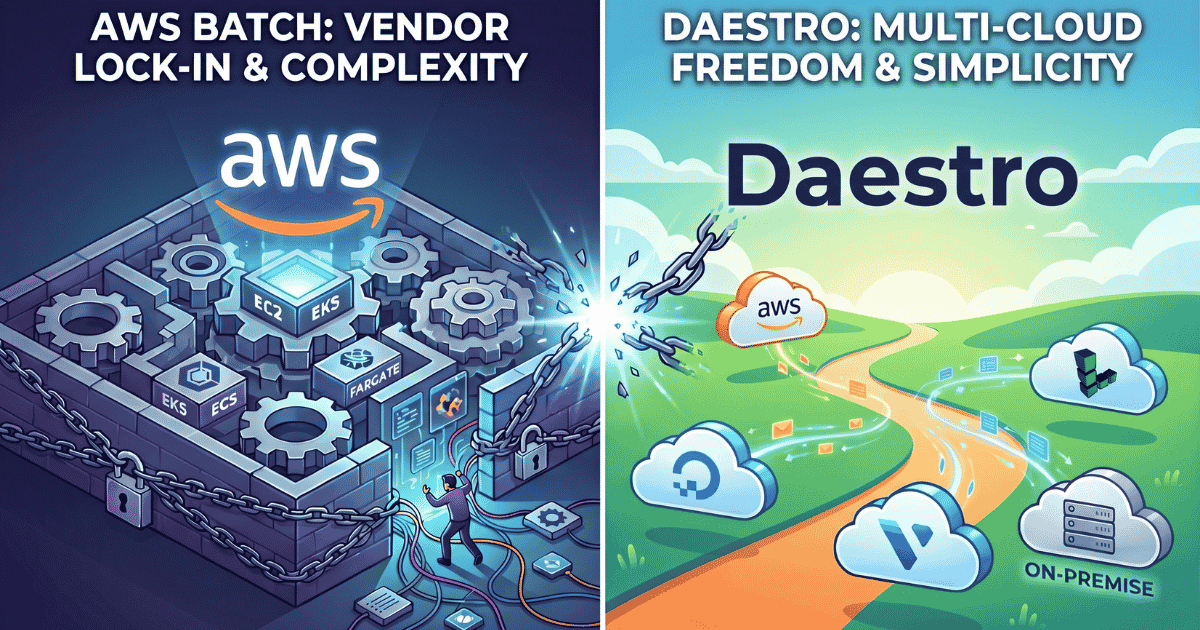
AWS Batch is closely tied to many other AWS services such as EC2, EKS, ECS and Fargate. This means you are limited to configurations and pricing for the products provided by AWS. Daestro offers cloud-agnostic and on-premises container orchestration for cron and batch jobs. You can run any kind of containerized jobs anywhere you want without any lock-in.
Daestro vs AWS Batch: Summary
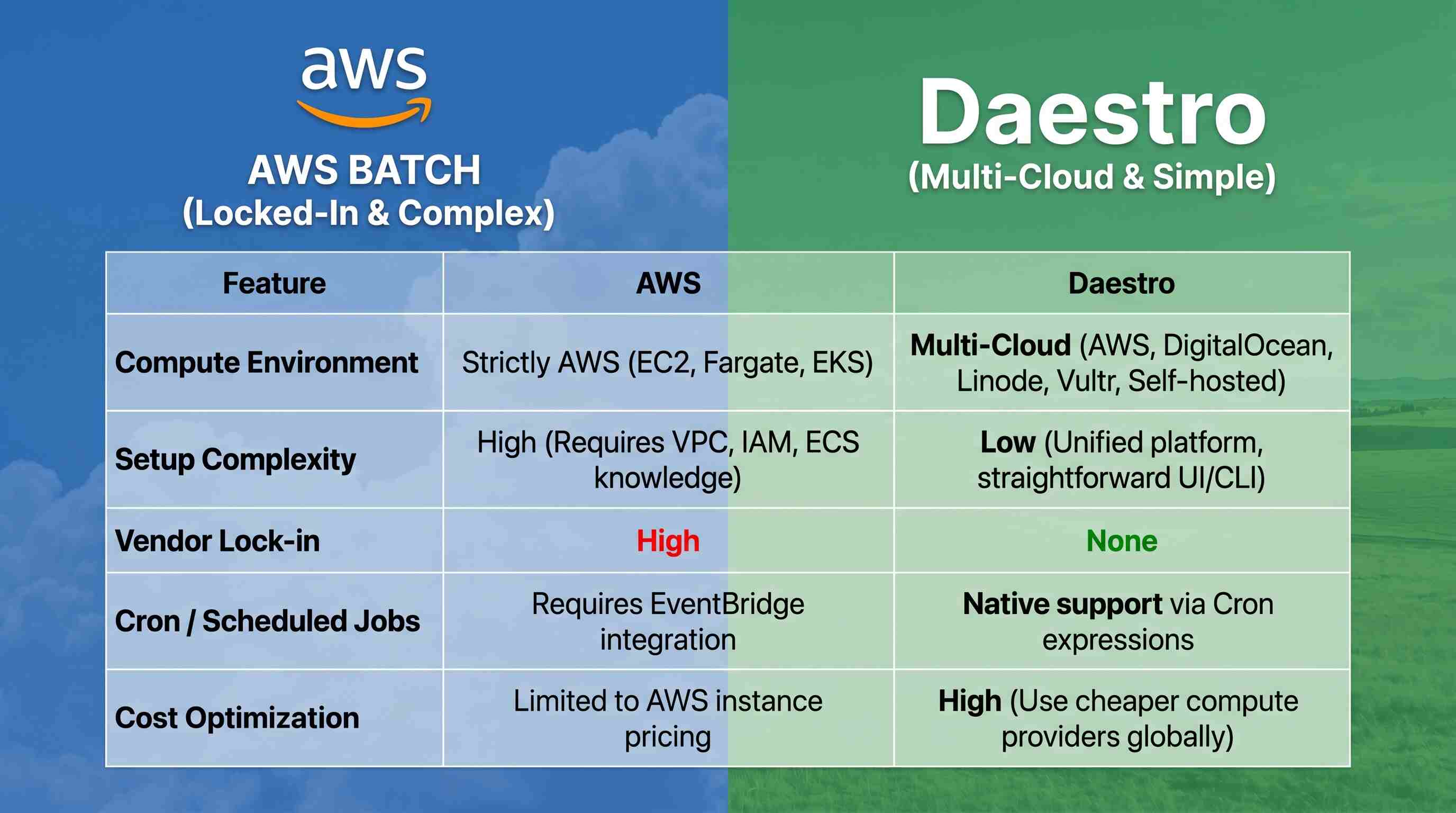
| Feature | AWS Batch | Daestro |
|---|---|---|
| Compute Environment | Strictly AWS (EC2, Fargate, EKS) | Multi-Cloud (AWS, DigitalOcean, Linode, Vultr, Self-hosted) |
| Setup Complexity | High (Requires VPC, IAM, ECS knowledge) | Low (Unified platform, straightforward UI/CLI) |
| Vendor Lock-in | High | None |
| Cron / Scheduled Jobs | Requires EventBridge integration | Native support via Cron expressions |
| Cost Optimization | Limited to AWS instance pricing | High (Use cheaper compute providers globally) |
What is AWS Batch
AWS lets you run containerized jobs on their infrastructure, be it EC2, ECS, EKS or Fargate. They manage the infrastructure and run the jobs that has been submitted. To use AWS Batch effectively, you will also need to integrate with other AWS services such as SQS to store the jobs, you may use lambda to trigger job submission based on an event and ECR to store docker image of your job.
The Challenges with AWS Batch
1. The AWS Ecosystem Lock-in
To use the AWS Batch we need to integrate with many other AWS services, which over time as we scale, creates a lock-in that makes it harder to move out of AWS ecosystem. Each services provided by cloud providers have different API and SDK which makes it harder to move across them easily.
Daestro solves this by providing a single interface to run your jobs across cloud providers and on-premise. This makes it easy to integrate multiple cloud providers and use the instances that offers best price to performance ratio for you workload.
2. Steep Learning Curve & Complexity
Running even a simple batch job in AWS requires setting up a lot of boilerplate infrastructure such as IAM roles for orchestration service and execution environment and VPCs (with subnets and security groups) among other things. Which increases the complexity of using AWS Batch and makes it harder for someone who is new to AWS.
3. Cost
AWS Batch itself doesn’t carry an additional charge, you pay based on the underlying AWS resources (Fargate, EC2 instances, etc.) you consume. AWS compute costs carry a premium compared to alternative cloud providers. Because you cannot bring your own compute from outside of AWS into AWS Batch, you are forced to pay AWS prices for all your batch processing needs.
How Daestro Helps You
Supports Multi-Cloud and On-Premise Compute
Daestro can run your jobs on your own cloud provider account. Daestro directly integrates with AWS, DigitalOcean, Vultr and Akamai Cloud, which means you just provide us with an API key and Daestro will manage infrastrucure to run your jobs.
Daestro also lets you connect your self-managed server using its agent, then all the jobs assigned to it will run in your own server, your data remains within your reach. Daestro just executes your job.
Powerful But Easy To Use
Daestro is very easy to use, it has a well-defined flow that doesn’t confuse users. You don’t need to configure VPCs or write complex IAM JSON policies just to run a task. You just define your compute environment, job queue and job definition, then you are good to go. If you want to run private container images, you can add container auth for those too.
If you don’t have any docker image and just want to run some Bash code, you can do that too in Job Definition. You will still get all the logs and metrics.
Significant Cost Savings
By breaking the vendor lock-in, Daestro allows you to drastically reduce your compute bills. You can utilize high-performance, low-cost bare metal servers from providers like Hetzner or OVH for your heavy batch processing, while still maintaining the centralized orchestration, retry logic, and queueing capabilities you would expect from a managed enterprise service.
Conclusion
If your infrastructure is already 100% committed to AWS and you have a dedicated DevOps team to manage the complex IAM and VPC requirements, AWS Batch is a solid choice.
However, if you value flexibility, simplicity, and the freedom to choose your own compute providers without sacrificing orchestration capabilities, Daestro is the suitable alternative. Daestro decouples your workload scheduling from the underlying cloud provider. This future-proofs your architecture and lets your engineering team focus on building features rather than wrestling with cloud configuration.